Farmhouse Decorating Mistakes: 10 Common Problems and Easy Fixes
A quick diagnostic for a farmhouse-style room that looks cluttered, themed or flat: ten common mistakes, why each one happens and a simple fix you can try the same day.

Most farmhouse decorating mistakes come from enthusiasm, not bad taste. You find a look you love, collect things that belong to it, and one day the room feels crowded, themed or strangely flat without any single piece being wrong.
The fixes are nearly always about taking away, grouping or varying, and rarely about getting more. Find the symptom that matches your room below, then work through the mistakes listed under it.
A two-minute diagnosis
Stand in the doorway and take a quick picture with your phone, then look at it at thumbnail size. A small image hides the detail and shows the overall pattern. Ask three questions:
- Is there nowhere for the eye to rest? The room is cluttered. Start with mistakes 1 to 3.
- Could you name the theme in one word? The room is themed. Go to mistakes 4 to 6.
- Does everything blur into one pale, even band? The room is flat. See mistakes 7 to 10.
If the room looks cluttered
1. Too many small accessories
Why it happens: small things are easy to bring home one at a time, and each seems harmless.
The fix: clear the surface completely. Put back one large piece, one medium and one small, grouped on a tray or a stack of books, and store the rest. Rotate pieces in later instead of showing everything at once.
2. Word signs on every wall
Why it happens: a sign is a quick way to fill a blank wall, and they turn up wherever the style is sold.
The fix: keep one, ideally with wording of your own, such as a family name or a place that matters to you. Give the other walls a mirror, a simple artwork or a planned group like a farmhouse gallery wall, and leave at least one wall bare.
3. Ignoring scale
Why it happens: small pieces feel like the safer choice, so a wide sofa ends up under one little frame and a big table under a tiny vase.
The fix: size the decor to the furniture. As a rule of thumb, art or a group above a sofa looks balanced at roughly two-thirds of the sofa’s width, and a centerpiece should look substantial from across the room. One large jug beats five small ones.
If the room looks themed
4. Everything distressed
Why it happens: worn finishes signal farmhouse so clearly that it is tempting to choose them every time.
The fix: limit distressed pieces to one or two per room and surround them with plain, clean surfaces. Wear reads as character only by contrast. The guide to vintage-inspired farmhouse accents explains how to use them sparingly.
5. A motif that takes over
Why it happens: one rooster, one cow print or one bunch of cotton stems is charming, so gifts and impulse finds follow, and soon the motif is on every shelf.
The fix: pick your favorite example and let it stand alone in the room. Move or pass on the others. The style should come from materials and colors, not from a repeated picture.
6. Fake greenery everywhere
Why it happens: faux stems need no care, so they multiply: a small plant on every shelf, a garland along every ledge.
The fix: gather them. One generous bunch of a single kind of stem in a large jug looks more natural than ten tiny pots. Keep to two or three spots of green per room, vary the height, and mix in fresh branches or a living plant where you can look after one.
If the room looks flat
7. Matching furniture sets
Why it happens: a sofa, chairs and tables that come as a set are simple to choose and feel like a sure thing.
The fix: break the set up. Move one piece to another room and bring in something of a different material or character: a wooden trunk in place of the matching side table, a woven chair instead of the second armchair. These farmhouse living room ideas give more options.
8. All white with no texture or contrast
Why it happens: white is the base of the style, and it is easy to assume that more of it is always better.
The fix: keep the white and add what it lacks: wood, a woven rug, linen, a knitted throw and a few black accents. A second and third neutral, such as oat and warm gray, give depth. The guide to the farmhouse color palette shows the proportions.
9. Wood tones that fight
Why it happens: furniture arrives at different times, and an orange-toned table, a gray-washed shelf and a red-brown floor end up sharing a room.
The fix: check undertones. Keep the woods that lean the same way, warm or cool, and choose one tone to lead. Separate the others with a rug, a runner or a painted piece, and repeat each remaining tone at least twice so it looks intended.
10. Decor that is all one height
Why it happens: jars, frames and pots of similar size are what most of us own, and lined up they form a flat row.
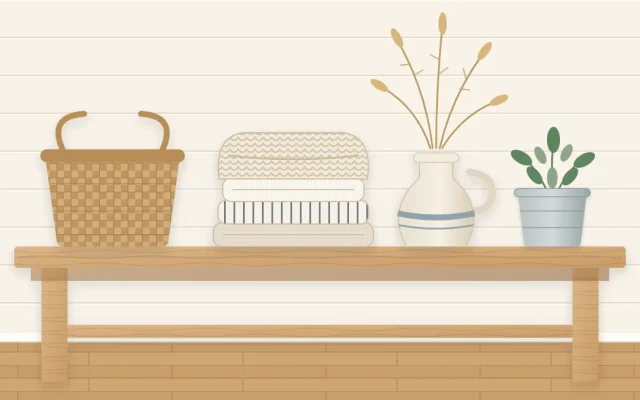
The fix: build a rough triangle. Add something tall, like branches in a jug or a lamp, something of middle height, and something low and wide, like a bowl or a stack of books. Stand smaller objects on books to lift them.
Fix one thing at a time
Choose the mistake that bothers you most and deal with that one first. Changing everything at once makes it hard to tell what helped. After each change, take another quick picture from the same doorway and compare it with the first.
Keep a box for the things you remove. Nothing has to leave the house for good: pieces that crowded one room often look right on their own in another, and a rested shelf is easier to restyle when the season changes.
Tip
When in doubt, take three things off any surface and wait a week before putting anything back. If you do not miss them, the surface was overfilled.
What a corrected room has in common
Whatever the starting problem, rooms that work share the same few qualities. There is a clear place for the eye to land and a clear place for it to rest. Materials vary while colors stay quiet. Old-looking and plain pieces sit side by side, and each object has enough room around it to be seen.
If your room has those four things, it is finished, however few accessories it holds.
Frequently asked questions
Why does my farmhouse decor look cluttered?
The usual cause is many small items spread across every surface. Small pieces compete with one another and leave no resting place for the eye. Clear each surface, return only a few pieces of different sizes in a single group, and store the others to rotate in later.
How do I keep a farmhouse room from looking themed?
Let materials carry the style instead of motifs. Wood, linen, woven fiber and stoneware in a quiet palette read as farmhouse on their own. Keep word signs, animal motifs and distressed finishes to one or two examples per room, and place them beside plain pieces.
Is an all-white farmhouse room a mistake?
Not if it has texture and a little contrast. White alone can look flat, but white combined with wood, a woven rug, linen, a chunky knit and a few black accents looks layered. Adding one or two soft neutrals, such as oat or warm gray, also helps.