Vintage-Inspired Farmhouse Accents: Adding Character Without Clutter
Ten vintage-inspired accents that give a farmhouse room character, from stoneware crocks to old books, plus simple rules for showing them sparingly so the room feels collected and calm.
The appeal of an old-looking jug or a scuffed wooden stool is that it seems to have a story. The risk is that twenty such stories told at once sound like noise, and a room meant to feel collected ends up feeling like a market stall.
A vintage-inspired farmhouse look depends less on how many characterful things you own and more on how few you show at a time. Here, vintage-inspired simply means new or secondhand pieces with an older look. Below are ten accents worth having, followed by the handful of rules that keep them from taking over.
Ten accents that carry the look
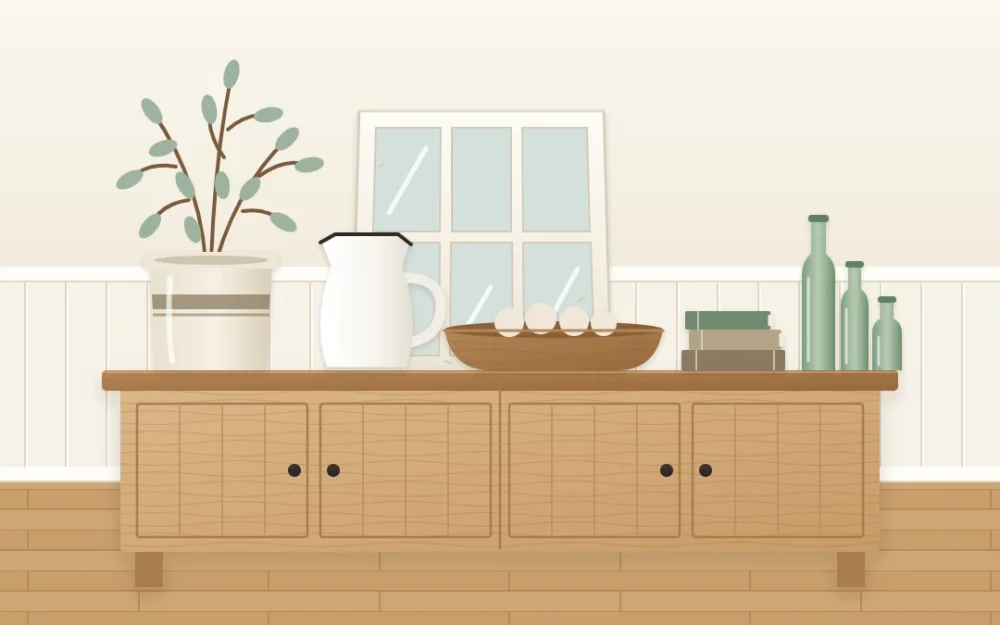
- Stoneware crocks and jugs. Heavy, matte and plainly shaped, they hold branches, wooden spoons or nothing at all. Stoneware in cream, gray or brown-banded glazes sits well with almost any palette.
- Enamel-look pitchers. White with a dark rim is the familiar version. One on a shelf or holding flowers on a table is enough to set the tone.
- Dough-bowl shapes. A long, shallow wooden bowl gives a table or island a low centerpiece that never blocks the view across it. Fill it with seasonal things or leave it empty.
- Glass bottles. Clear, green or amber bottles look best in a tight group of three or five in mixed heights, with a single stem in one or two of them.
- Wooden crates and stools. A crate turned on its side holds books or blankets; a small stool works as a plant stand or a side perch for a lamp. Both carry only what their maker rates them for.
- A ladder-style blanket rack. It adds height and holds textiles you would otherwise fold away. Lean it on a clear stretch of wall away from walkways, and follow the maker’s guidance on securing it.
- Window-style frames. A divided wooden frame, with or without mirror panes, gives a blank wall some structure. Leaning one at the back of a sideboard is the simplest way to use it.
- Scale-like and lantern-like shapes. A kitchen-scale silhouette on a shelf or a metal lantern with a flameless LED candle inside brings in dark metal and an interesting outline.
- Grain-sack stripes. A cushion, a runner or a tea towel with a few simple woven or printed lines adds pattern without adding color.
- Old books. Cloth-bound books in faded tones, stacked flat in twos and threes, lift smaller objects and fill the gap between tall and short pieces.
One character piece per view
Stand in each doorway and at each spot where you usually sit, and look at what is in front of you. In each of those views, let one vintage-inspired piece be the obvious character: the crock on the entry table, the ladder rack in the corner, the window frame on the sideboard.
Everything else in that view plays a supporting part. If two strong pieces compete, move one to a different wall or a different room. You will notice both more once they are apart.
Group collections instead of scattering them
Five bottles spread across five surfaces read as clutter. The same five bottles shoulder to shoulder on one tray read as a collection. Grouping is the single most effective way to keep character without mess.
- Gather like with like: all the stoneware together, all the glass together.
- Vary the heights within the group and let the pieces overlap slightly when seen from the front.
- Give the group a boundary such as a tray, a shelf or a stack of books.
- Leave the neighboring surface clear so the group has breathing room.
Tip
Keep a small box in a cupboard for the pieces that are resting. Swapping two or three items in and out every few months keeps the room fresh and stops the urge to display everything at once.
Set old-looking pieces against plain ones
Worn surfaces show up best beside something smooth and simple. A crock looks richer on a clean white shelf than on a busy patterned cloth, and a weathered stool looks deliberate beside a plain modern sofa.
Aim for a mostly quiet background of solid colors, simple shapes and uncluttered walls, with the vintage-inspired pieces as the punctuation. The article on mixing modern and rustic decor walks through how to pair the two, and the overview of modern farmhouse style explains the cleaner version of the look that these accents sit within.
Choose new pieces with honest materials
A new piece does not need to pretend to be old. What matters is that it is made of what it appears to be made of. Look for:
- real wood with visible grain, in place of a printed wood pattern;
- ceramic with some weight and a slightly uneven glaze;
- metal with a matte or brushed surface;
- glass with a little color or thickness to it;
- woven cotton or linen for anything striped.
Be cautious with factory finishes that imitate wear very evenly, such as identical scuffs on every corner. A plain, well-made piece will gain its own marks with use and usually looks better for it.
Treat old painted pieces as display
Secondhand finds with a worn painted surface are best enjoyed as they are, on a shelf or sideboard, and not used for serving or storing food. The same goes for decorated jars and containers of any age.
This guide does not cover refinishing. If a piece needs more than a gentle dusting to look right in your room, it is usually simpler to choose a different piece.
Before you hang anything
If you would like a window-style frame on the wall instead of leaning, choose hardware to suit your wall type and the weight of the frame, and follow the manufacturer instructions. For a large or heavy frame, get help if you are unsure.
Signs that it has tipped into clutter
Check the room against this short list every so often:
- You have to move three things to put a cup down.
- Every surface holds something, with no empty stretch anywhere.
- Small objects outnumber large ones in most views.
- Several pieces carry lettering or numbers that compete for attention.
- Dusting has become a project.
If two or more apply, clear one surface completely, put back only the largest piece and add one companion. Repeat around the room. The list of common farmhouse decorating mistakes covers the other habits that tend to creep in alongside over-collecting.
Frequently asked questions
What does vintage-inspired mean in farmhouse decor?
It means pieces with an older look, whether they are newly made or bought secondhand. Think stoneware crocks, enamel-look pitchers, wooden bowls, glass bottles and cloth-bound books. The aim is a sense of character and age in the room, not a collection of valuable antiques.
How do I stop vintage decor from looking cluttered?
Show less at once. Give each view of the room one main character piece, gather similar items into a single group on a tray or shelf, and leave some surfaces completely empty. Keep the surplus in a box and rotate pieces in and out through the year.
Can I use old painted containers for food?
Treat old painted or decorated containers as display pieces only. Use them to hold branches, wooden utensils or nothing at all, and keep food in containers made and sold for that purpose. The same applies to jars you have painted or decorated yourself.