Farmhouse Entryway Ideas for a Welcoming First Impression
Build a warm farmhouse entry from a bench, pegs, a mirror, a basket and a runner, with a step-by-step arrangement for one wall and a stacked version for tiny entries.

At a glance
- Difficulty
- Easy
- Time
- About 1 to 2 hours, plus any hanging
- Best for
- A hallway or a single wall beside the front door
- Look
- Warm, practical, lightly rustic
What you need
- Wooden bench or slim console
- Peg rail or row of hooks
- Mirror or simple framed piece
- Large woven basket
- Flat-woven runner
- Jug of branches or a small lamp
- Tape measure
The space by the front door has a hard job. It is the first thing anyone sees, and it is also where shoes, bags, keys and coats land several times a day. The best farmhouse entryway ideas accept both facts: they make the everyday things part of the look instead of hiding them.
You do not need a hall for this. One stretch of wall about as wide as a bench is enough, and a tiny entry can manage with less. The method below builds an entry from a handful of elements, one layer at a time, so you can stop whenever the wall feels finished.
The six elements of a farmhouse entry
Almost every welcoming entry is some combination of these. Pick four to start.
- A seat or surface: a wooden bench, or a slim console if you never sit to put on shoes.
- Pegs or hooks: a short row for the things you reach for daily.
- A mirror or one framed piece: something at eye level that is not storage.
- A basket: for shoes, scarves or a throw.
- A runner: a durable, flat-woven one that can take wet shoes.
- Something alive or lit: a jug of branches, or a small lamp.
If you are new to the style and unsure which finishes to choose, the beginner’s guide to farmhouse decor covers the basic materials and colors before you buy anything.
Arrange one wall, step by step
- Clear and measure. Empty the wall and measure its width and the depth you can spare without narrowing the walkway. Check that the door opens fully.
- Place the bench or console. Center it on the wall, or push it toward the corner farthest from the door swing. A piece that fills roughly two thirds of the wall width leaves breathing room at each end.
- Set the hook line. Mark a level line for pegs or hooks. Around 60 to 66 in (152 to 168 cm) from the floor is a common starting point for adults; hold a coat up and check that it clears the bench.
- Add the mirror or frame. Hang it between or beside the hooks, with its center near eye level, roughly 57 in (145 cm) from the floor. Above a console, leave a gap of about 6 to 8 in (15 to 20 cm) between tabletop and frame.
- Slide in a basket. One large basket under the bench looks calmer than a row of loose shoes. Two matching ones work under a longer bench.
- Roll out the runner. Let it run along the wall in the direction people walk, with its edge a few inches in front of the bench legs.
- Finish with one soft thing and one tall thing. A striped cushion on the bench, a jug of branches or a lamp on the console. Then stop.
Before you hang anything
Hooks, mirrors and shelves all need fixings chosen for your wall type and for the weight they will hold, coats and bags included. Follow the manufacturer instructions for both the item and the hardware, and get help with a large mirror if you are unsure.
Make the hooks part of the decor
A row of pegs looks good only when what hangs on it looks good. Treat it as a small display that happens to be useful, and limit it to one item per peg.
- A straw hat, a canvas tote and one jacket in a neutral color are enough for a row of five pegs.
- Leave at least one peg empty. Guests need somewhere to hang a coat, and the gap keeps the row from looking loaded.
- Add one thing that is not practical at all: a small wreath of greenery or a bundle of faux stems tied with twine.
- Move the bright raincoat and the gym bag to a closet or the back of a door.
If the wall still feels bare above the pegs, one simple framed piece is usually plenty. There are more options for that spot in these farmhouse wall decor ideas.
Scale it down for a tiny entry
When the door opens straight into a room, or the wall is barely wider than the door, stack the elements vertically instead of spreading them out. Think of a column about 24 in (60 cm) wide.
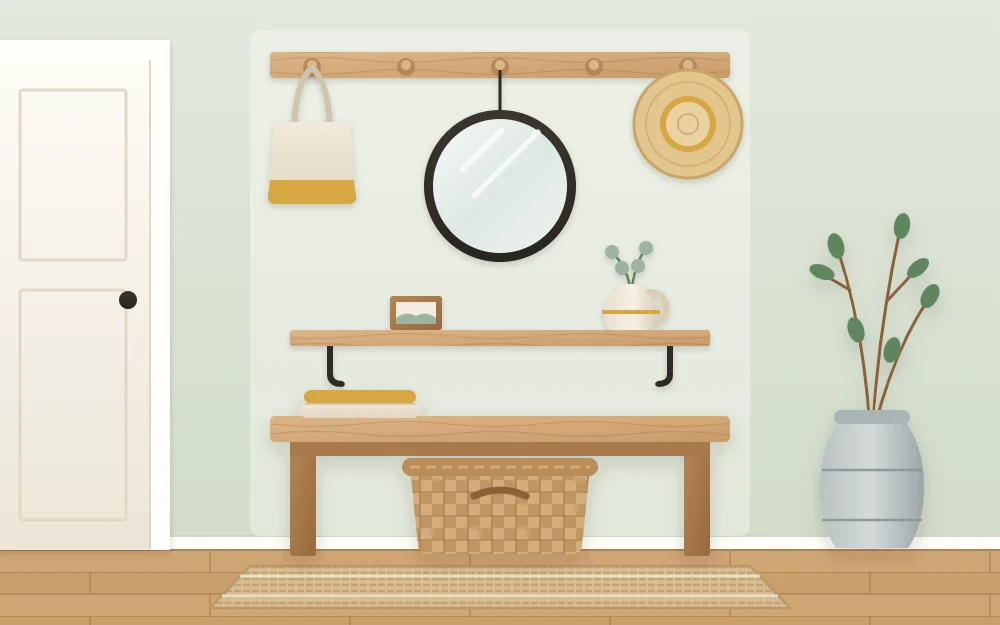
- Top: a short peg rail with three pegs.
- Middle: a round mirror, which softens the straight lines around a door.
- Below it: a slim shelf just deep enough for keys and a small jug.
- Floor: a narrow bench or a single stool, a basket and a small runner.
No room for a bench at all? Keep the pegs, the mirror and one floor basket. Three elements still read as an entry, and the basket gives shoes a home.
Baskets, runner and lamp: the finishing layer
Choose the basket by what goes in it. Shoes need a sturdy, open one that is easy to shake out; scarves and a spare throw look better in something lidded or softly woven. For weaves, sizes and how full to fill them, see the guide to using decorative baskets around the house.
For the runner, a flat weave in jute, cotton or a washable blend suits a door that sees dirt. Stripes or a small check hide marks better than a plain pale rug, and a rug pad underneath helps keep it in place.
A lamp makes an entry feel lived in after dark. Use a plug-in lamp if there is an outlet nearby, or a rechargeable one if there is not. Anything wired into the wall or ceiling is a job for a licensed electrician.
Tip
Keep a small wooden bowl or a shallow tray on the console or shelf for keys. One fixed spot stops the whole surface from filling up.
Common entry problems and quick fixes
- It looks cluttered by midweek. There are too many hooks in use. Cut back to one item per person and move the rest.
- It looks cold. Everything is hard: wood, metal, glass. Add a cushion, a woven basket and the runner.
- It looks flat. Everything sits at one height. Add something tall, such as branches in a jug, and something low, such as the basket.
- It looks unfinished. Nothing repeats. Echo one color or material twice, for example black hooks and a black lamp base.
Frequently asked questions
What if my front door opens straight into the living room?
Claim a narrow strip of wall beside the door and treat it as the entry. A short peg rail, a round mirror and one floor basket are enough to mark it out, and a small runner on the floor draws a visual line between the door and the rest of the room.
Should I choose a bench or a console table?
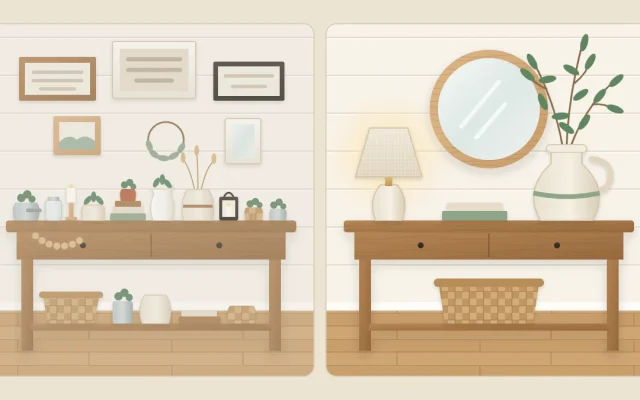
Choose a bench if people sit to put on shoes or if you want baskets underneath. Choose a slim console if the space is shallow and you mostly need a surface for keys, a lamp and a jug of branches. In a very narrow entry, a single stool can stand in for both.
How do I keep an entry from looking messy?
Limit what is on show. Keep one item per peg, give shoes a basket instead of the floor, and set a bowl or tray as the only place for keys and mail. Anything bright, bulky or rarely used moves to a closet, so the visible things are the good-looking ones.