Decorative Baskets in Farmhouse Decor: Where and How to Use Them
Where baskets look right in a farmhouse-style room, how to choose weave, color and size, how many to use, and how to fill one so it looks styled rather than stuffed.
A basket is one of the few farmhouse pieces that earns its place twice. It brings woven texture and a rounded shape into a room full of straight lines, and it quietly holds the throw, the magazines or the lemons. The trouble starts when baskets multiply: five different weaves in one room read as clutter, not charm.
Used well, decorative baskets behave like any other accent. You choose a few, give each one a clear job and leave space around it. Here is where they look right, how to pick weave, color and size, and how to fill one so it looks styled rather than stuffed.
Where baskets look right, spot by spot
Start with the place, not the basket. Each spot in a room suits a particular shape, and matching the two is most of the work.
| Spot | Basket shape | What goes in it |
|---|---|---|
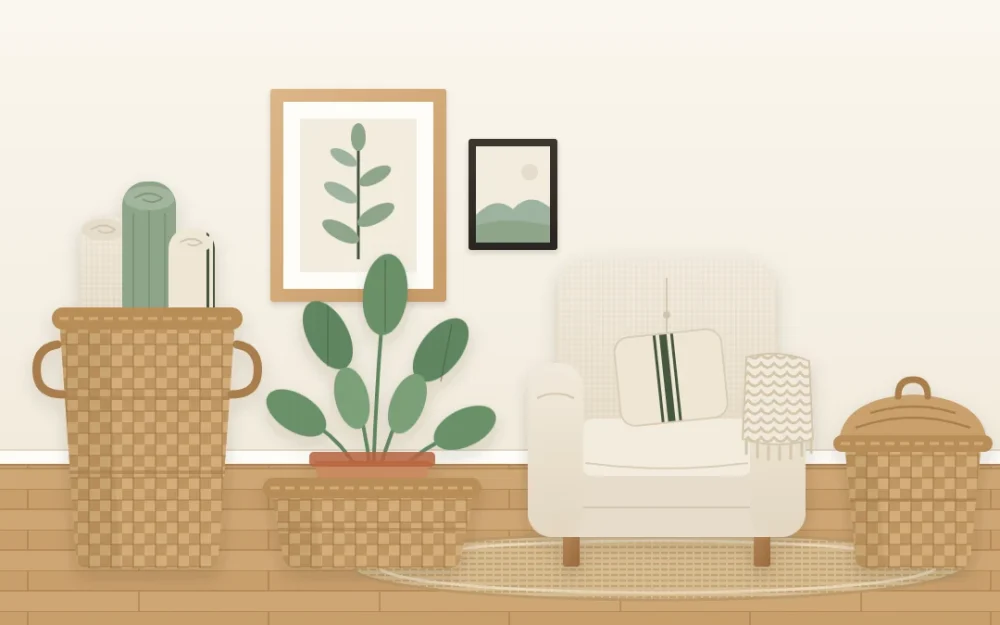
| Floor beside the sofa | Tall, sturdy floor basket | Two or three rolled throws |
| Beside an armchair | Lidded basket | Whatever you like; the lid is the look |
| Coffee table or console | Shallow basket or woven tray | A jug, a cup, a small plant |
| Open shelf | Small matching pair | Folded linens, or nothing visible |
| Wall | Flat round baskets | Nothing; they are relief decor |
| Kitchen counter | Wire or open-weave basket | Lemons, apples, onions |

Floor baskets: the big shapes
A floor basket is furniture-sized decor, so one or two per room is plenty. Beside a sofa, a basket that stops somewhere below the arm, roughly 14 to 18 in (36 to 46 cm) tall as a starting point, looks settled rather than looming. Roll the throws instead of folding them and stand them upright so the ends show like a bundle.
A low, wide basket suits a potted plant; keep the plant in its own pot on a saucer inside so water never reaches the weave. A sturdy open basket holding a few short, clean logs works as decor in a bare corner, purely for the shape and the color of the bark.
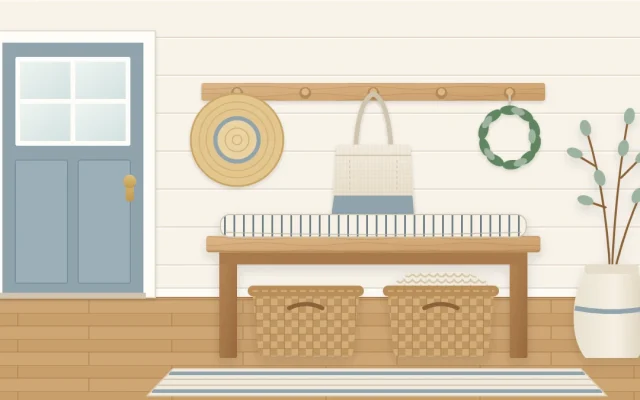
A lidded basket beside an armchair is the calmest option of all, because nothing shows. By the front door, a floor basket under a bench does the same quiet work for shoes, and it is one of the simplest ways to make an entry feel put together.
Tabletop and shelf baskets
On a table, a shallow basket or woven tray is a frame. It gathers a jug, a cup and a small plant into one group, so the surface looks arranged instead of scattered. Pick one that covers no more than about a third of the tabletop.
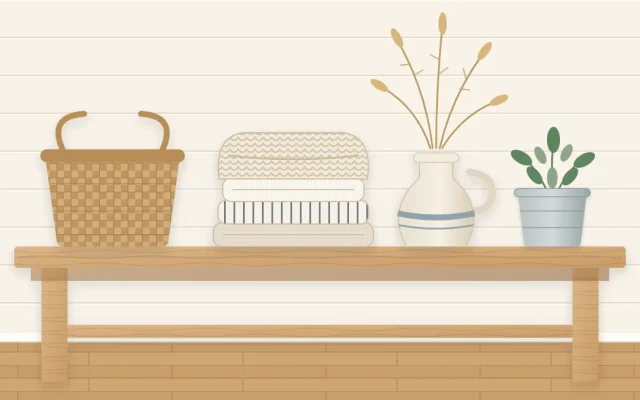
On open shelves, baskets are the place for rest. A shelf of dishes, books and jars can look busy, and one or two plain baskets break it up with a solid block of texture. A matching pair side by side reads as deliberate; three unrelated ones on three shelves do not.
In the kitchen, a wire or open-weave basket turns ordinary produce into color. Lemons, apples or onions are enough. Keep it away from the cooktop and choose a basket you can wipe or rinse.
Wall baskets as relief decor
Flat, round baskets on a wall give you pattern and shadow without any color at all, which is why they suit a neutral room so well. Three or five in mixed sizes, overlapping the way plates would, make a soft alternative to frames. Lay them out on the floor first and keep the gaps tight, about 2 in (5 cm), so they read as one cluster. They also mix happily with frames if you are planning a farmhouse gallery wall.
Before you hang anything
Even light baskets need the right fixing. Choose hardware for your wall type and the weight of each basket, and follow the manufacturer instructions that come with it.
Choosing weave, color and size
Most baskets sold as wicker are made of rattan, willow, seagrass, jute or water hyacinth, and each has its own character.
- Weave: chunky, open weaves feel rustic and relaxed; tight, fine weaves feel tidier and a little more modern. Wire baskets add a darker, harder line.
- Color: honey and natural tones warm up white walls. Gray-washed or black baskets cool things down and tie in with black metal lamps or frames.
- Size: go a size larger than feels obvious. One generous basket looks calmer than three small ones doing the same job.
A basket is usually the roughest surface in the room, so it pairs best with something smooth nearby: stoneware, glass or a painted finish. That contrast is the idea behind layering natural materials and textures.
How many is too many
A loose rule of thumb: keep to two or three basket types in any one room, and repeat them rather than adding a fourth. Two seagrass floor baskets and a wire fruit basket look collected. A seagrass, a rattan, a willow, a rope and a wire basket look like a display stand.
Group baskets in odd numbers when they sit together, and vary the height within the group: tall, medium, low. If you can see more than about five baskets from where you are standing, take one away and see whether you miss it.
Tip
Count empty baskets too. A basket with nothing in it still takes up visual space, so give it a job or put it away.
Filling a basket so it looks styled, not stuffed
Stop at about three-quarters full. A basket packed to the rim hides its own shape, while one with a little room shows the weave on the inside as well.
- Limit each basket to one kind of thing: only throws, only magazines, only fruit.
- Let one item break the rim, such as a blanket corner or a few stems, and keep the rest below it.
- Line open-weave baskets with a plain cotton or linen cloth when the contents are small or snag easily. Fold the edge over the rim by a finger width so it looks intended.
- Keep liners plain or softly striped, and wash them according to their care labels.
Then step back to the doorway. If your eye lands on the basket’s shape before its contents, it is doing its job.
Frequently asked questions
How many baskets should one room have?
There is no fixed number, but a room usually feels calm with two or three basket types repeated, and no more than about five baskets in view at once. If the baskets are the first thing you notice when you walk in, remove one and look again the next day.
Do all the baskets in a room need to match?
No. They only need to relate. Keep them in the same color family, or repeat one weave in different sizes, and add a single contrast such as a wire basket. Mixing many unrelated materials and tones is what makes a room of baskets look accidental.
What can go in a basket that is purely for looks?
Soft, simple things work best: rolled throws, a spare pillow, a potted plant in its own pot and saucer, a few magazines or a bundle of faux stems. Keep to one kind of item per basket and leave some of the inside weave showing.