Farmhouse Coffee Table Styling: A Simple Tray Formula
A repeatable tray formula for styling a coffee table: something tall, something low, something living and one personal object, with layouts for round, square and long tables.
At a glance
- Difficulty
- Easy
- Time
- About 20 to 30 minutes
- Best for
- Coffee tables in a family living room
- Look
- Relaxed, neutral, lightly rustic
What you need
- Wooden tray or low basket
- Stoneware jug or pitcher
- Fresh or faux stems
- Two or three books
- Small wooden bowl
- String of wooden beads or another personal object
A coffee table tends to end up one of two ways: completely bare because nothing seemed right, or buried under remotes, mail and three half-finished ideas. Farmhouse coffee table styling sits between the two. It is a small, relaxed group of things that looks good from the sofa and still leaves room for a cup.
The easiest way to get there is a formula you can repeat with whatever you already own. Five pieces, one tray, and a rule about empty space. Once you know it, restyling for a new season takes minutes.
The tray formula in one line
Tray + something tall + something low + something living + one personal object.
The tray does the gathering. Without it, five objects are five separate things on a table; inside it, they become one arrangement that you can lift off in a single move when you need the whole surface. A wooden tray, a low woven basket or a shallow dough-bowl shape all work, as long as the base is flat enough for a jug to stand steadily.
Build it step by step
- Clear the table completely. Start from nothing, wipe the top and put the remotes aside for now.
- Set the tray. Choose one that covers roughly a third to a half of the tabletop. Place it in the center of a small table or toward one end of a long one.
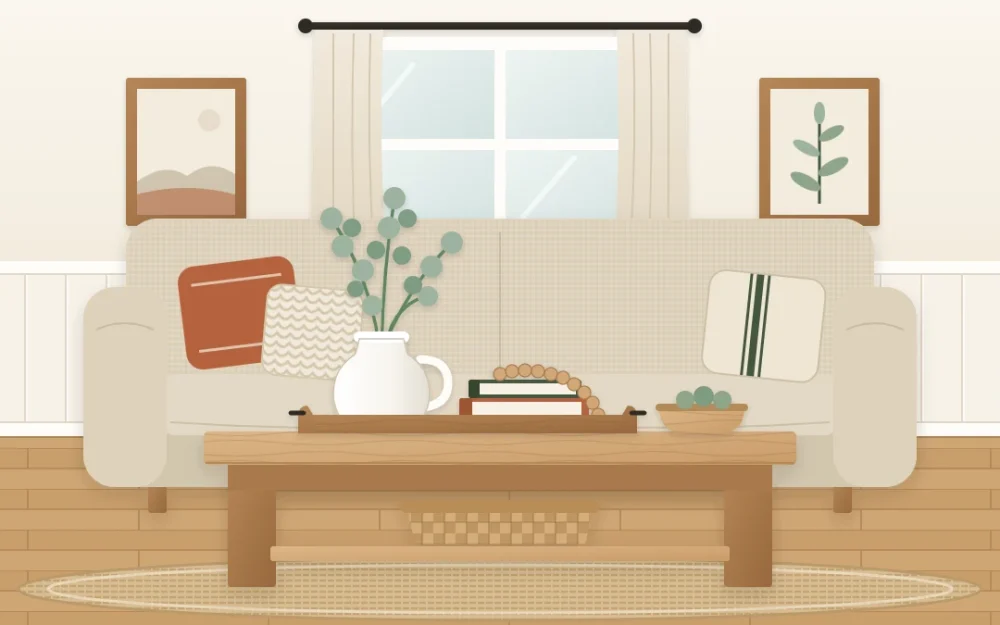
- Add the tall piece. A stoneware jug or pitcher with a few stems goes toward the back of the tray. Keep it low enough to see over from the sofa; around 12 to 16 in (30 to 40 cm) including stems is a comfortable starting point.
- Add the low piece. A stack of two or three books, or a small wooden bowl, sits beside the jug. Turn the spines away or choose plain covers if the titles feel busy.
- Add something living. A small potted plant, a bunch of fresh greenery or good faux stems. If the jug already holds green stems, this step is done.
- Add one personal object. A string of wooden beads draped over the books, a found stone, a small framed snapshot, a candle. One, not four.
- Check the clear space. About a third of the table should still be empty, on the side where people actually sit.
Good to know
Flameless LED candles are the easy default on a coffee table, where sleeves, stems and pages are always close by. If you light a real candle, keep it well away from stems and paper and never leave it unattended.
Why the heights matter
An arrangement looks flat when everything is the same height, and restless when nothing relates. Aim for three levels: tall (the jug), middle (a plant or a bowl on the books) and low (beads, a small dish). Your eye should travel in a loose triangle from the highest point down to the lowest.
Overlap things slightly. Let the beads trail over the edge of the books and tuck the bowl in front of the jug rather than lining everything up with gaps between. Objects that touch or overlap read as one group.
Keep the palette short as well: wood, white or cream ceramic, green, and one darker note such as a black metal dish. The same few materials can then repeat on the shelves and side tables, which is the thread running through these farmhouse living room ideas.
Adjust the formula to your table shape
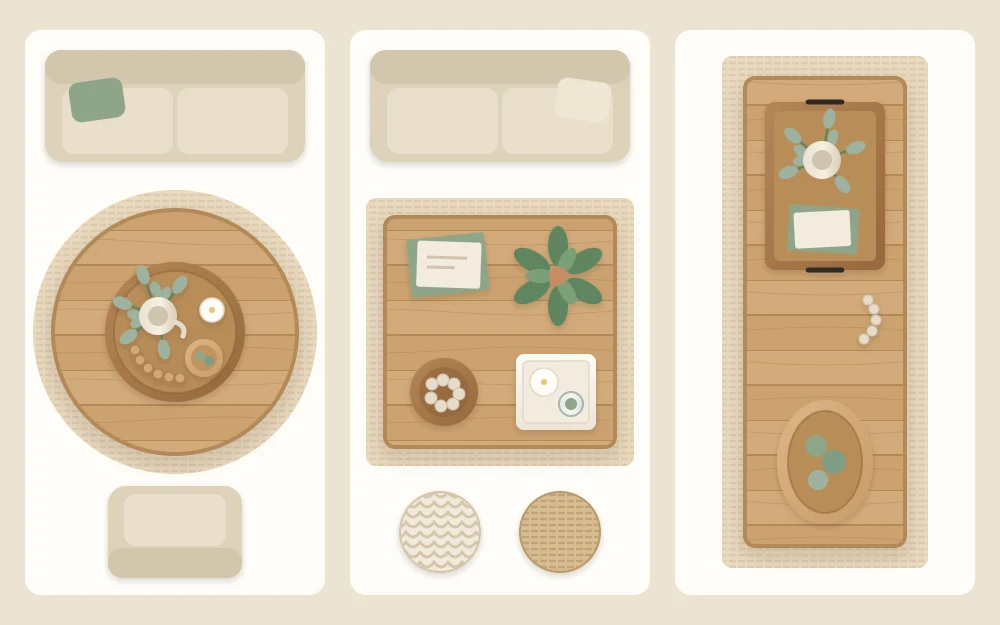
Round tables
Use a round tray or a low round basket in the center and build one compact group inside it. Every seat sees the arrangement from a different side, so turn the table as you work and avoid giving it an obvious back.
Square tables
A large square top can swallow a single tray. Divide it loosely into four quarters: the tray group in one, a stack of books in another, a low bowl in the third, and the fourth left empty for cups.
Long rectangular tables
Place the tray toward one end and balance it with a single low piece, such as a wooden bowl, at the other. Leave the middle clear. Two full arrangements on one long table usually compete with each other.
Homes with children or pets
You know your household best, so adapt the formula rather than giving up on it.
- Swap the ceramic jug for a wooden vase, a lidded basket or a metal pitcher that survives a knock.
- Use faux stems, and skip small loose objects altogether.
- Choose a tray with handles so the whole arrangement can move to a high shelf in one trip.
- Make the personal object a stack of picture books that are meant to be handled.
A soft basket of books plus one sturdy plant placed out of reach elsewhere in the room can be the whole arrangement for a few years, and it still looks intended.
Small swaps that keep it fresh
Because the formula stays the same, you only change one or two pieces at a time.
- The stems: green branches in spring, dried grasses in late summer, bare twigs in winter.
- The low piece: a bowl of pine cones, lemons or wooden beads.
- The vessel: trade the jug for a cluster of glass jars in mixed heights; there are more ways to use them in these mason jar decor ideas.
The same thinking, scaled up and stretched out, works on a dining table too. The guide to farmhouse table centerpiece ideas covers runners, longer arrangements and how low to keep things when people need to see each other.
When it still looks off
- Too cluttered: take out everything that is not one of the five pieces. Remotes go in a lidded box or a drawer.
- Too sparse: the tray is too small for the table. Size up, or add a stack of books under the bowl.
- Too stiff: everything is centered and upright. Angle the books, let the stems lean, drape the beads.
- Too matched: all one material. Add a contrast, such as glass beside wood or dark metal beside cream.
Tip
Sit down in each seat before you call it done. An arrangement that looks balanced from above can block the view from the sofa.
Frequently asked questions
How much of a coffee table should be left empty?
A useful rule of thumb is to leave about a third of the surface clear, on the side nearest the seats. That gives everyone a place for a cup or a book and keeps the arrangement looking like a choice instead of a pile.
Where do the remote controls go?
Give them one hidden home that is still within reach: a small lidded box on the tray, a shallow basket on the shelf under the table, or a side table drawer. If they have a fixed spot, they stop drifting across the tabletop.
Does the tray have to be wood?
No. Wood is the most common farmhouse choice because it warms up a pale room, but a low woven basket, a galvanized metal tray or a shallow wooden bowl works the same way. Pick the material your table is not, so the tray stands out from the surface beneath it.