Farmhouse Mantel Decor: How to Style a Mantel, Shelf or Console
A four-part method for a balanced mantel: an anchor piece, height on one side, a lower group on the other and a connector, with symmetrical and asymmetrical layouts compared.

A mantel is a long, narrow stage at eye level, which is exactly why it is hard to get right. Line objects up along it and it looks like a shop shelf; put one thing in the middle and it looks forgotten. Good farmhouse mantel decor is neither. It is a few pieces arranged so the eye moves across them in one easy sweep.
The method here has four parts: an anchor, height on one side, a lower group on the other, and something that connects them. It works just as well on a console table or a long shelf, so you can use it whether or not your home has a fireplace.
Start with one anchor piece
The anchor is the largest thing in the arrangement, and everything else answers to it. In a farmhouse room that is usually a round or arched mirror, a simple framed landscape or sketch, a window-style frame, or a large wreath.
As a loose guide, an anchor about two thirds the width of the mantel looks generous without crowding the ends. Place it in the center for a formal look or shift it a hand’s width to one side for a more relaxed one.
You can hang the anchor or lean it. Leaning looks casual and lets you overlap a smaller frame in front; hanging keeps the shelf clear. If the wall above is wide and empty, these farmhouse wall decor ideas will help you choose the piece itself.
Before you hang anything
Choose hardware for your wall type and the weight of the piece, and follow the manufacturer instructions. A leaning mirror or frame needs securing too, so follow the maker’s guidance, and get help with anything large or heavy if you are unsure.
Add height, a low group and a connector
With the anchor in place, build outward in three moves.
- Height on one side. Two or three tall, slim things: wooden candlesticks in staggered heights, a tall jug of branches, a narrow lantern. The tallest should reach somewhere between half and two thirds of the way up the anchor.
- A lower group on the other side. Something wider and shorter to balance the tall side: a small stack of books with a bowl on top, a squat stoneware crock, a potted plant.
- A connector. One horizontal or trailing element that links the two sides, such as a low garland, a string of wooden beads or a trailing plant.
Then count. Five to seven objects is usually enough for a mantel around 60 in (150 cm) long, and odd numbers tend to settle more easily than even ones.
Symmetrical or asymmetrical?
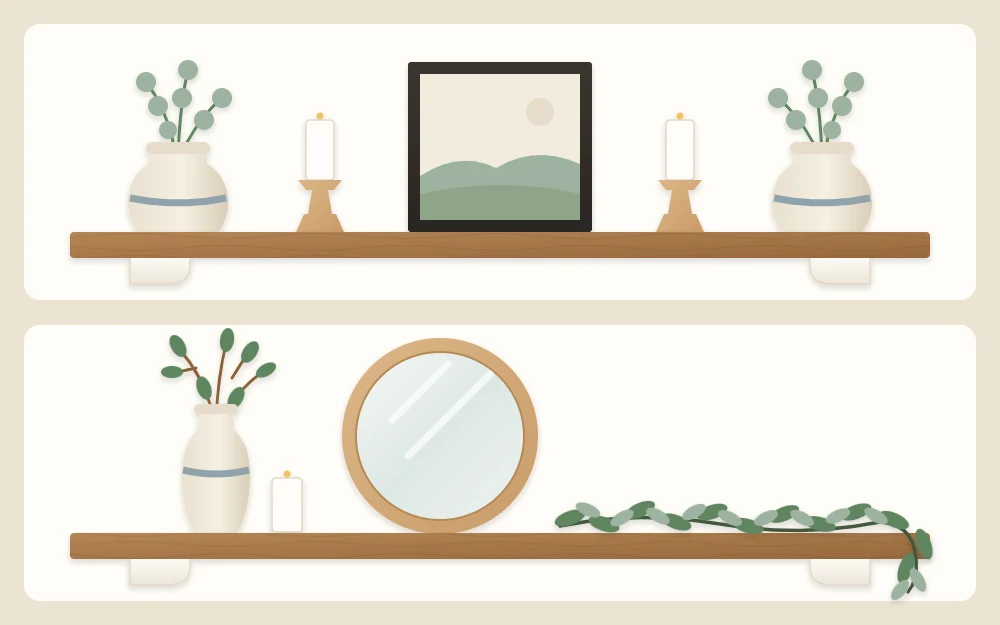
Both layouts are farmhouse; they simply set a different mood. The choice depends on the room and on what you already own.
| Symmetrical | Asymmetrical | |
|---|---|---|
| How it is built | Central anchor, matching pieces at each end | Anchor in the center or off-center, tall side and low side |
| Mood | Calm, traditional, tidy | Relaxed, collected, modern |
| Suits | A centered fireplace, a formal room, matching pairs | An off-center wall, a television nearby, one-off finds |
| Watch out for | Stiffness; it can look staged | Lopsidedness; one side can feel heavier to the eye |
To loosen a symmetrical mantel, keep the pair but vary what is in it: the same jugs with different stems, for example. To steady an asymmetrical one, squint at it. If one side looks darker or denser, move a small dark object across or add a little greenery to the lighter side.
Layer and overlap
Depth is what separates a styled mantel from a row of things. Even a shallow shelf has a back, a middle and a front, so use all three.
- Back: the anchor, plus perhaps a smaller frame leaning against it and overlapping one corner.
- Middle: the tall pieces and the main vessels.
- Front: small, low things, such as beads, a tiny dish or the trailing end of a garland.
Let objects touch and overlap by an inch or two instead of spacing them evenly. Repeat one material three times across the shelf, such as wood in the candlesticks, a frame and the beads, so the arrangement feels related to itself and to the rest of your farmhouse living room.
If the fireplace or stove is used
A fireplace that actually burns changes what belongs above and around it. Follow the appliance manufacturer guidance on clearances, and keep dried stems, greenery, garlands, fabric and paper well away from heat. That includes anything trailing over the front edge of the shelf.
Flameless LED candles are the simplest choice for candlesticks and lanterns on a mantel. If you use real candles, keep them clear of stems and frames and never leave them burning in an empty room.
No fireplace? Use a console or a long shelf
The same four parts work on any long surface against a wall: a console behind the sofa, a sideboard, a long shelf in a hallway. The differences are small.
- On a console, the anchor usually hangs on the wall above, with roughly 6 to 8 in (15 to 20 cm) between tabletop and frame so the two read as one unit.
- A console is deeper than most mantels, so the low group can be larger: a tray, a lamp, a wide bowl.
- Use the floor beneath it. A basket or a pair of stools under a console does what the firebox opening does for a mantel: it gives the arrangement a base.
- A plug-in or rechargeable lamp can take the place of the tall side.
Edit for the seasons without starting over
Keep the anchor and the main vessels all year. Change only what is in the vessels and the connector.
- Spring: green branches and a light string of beads.
- Summer: fewer pieces overall, with one jug of fresh or faux greenery.
- Fall: warmer colors, a few small pumpkins in the low group and a leaf garland as the connector. The guide to fall farmhouse decor has more ideas.
- Winter: evergreen stems, bare twigs and extra flameless candles.
When you add a seasonal piece, take an everyday one away. The count stays the same, and the mantel never tips from styled into crowded.
Frequently asked questions
How many things should go on a mantel?
It depends on the length, but five to seven objects including the anchor is a comfortable range for an average mantel. Fewer, larger pieces look calmer than many small ones. If you cannot see any of the shelf surface between groups, remove one or two items.
What if a television hangs above the mantel?
Treat the screen as the anchor and keep everything else low so nothing blocks the picture. An asymmetrical layout works well: a slightly taller group at one end, a low bowl or stack of books at the other, and a simple garland or string of beads along the front.
Is it better to lean a mirror on the mantel or hang it?
Leaning looks relaxed and lets you layer a smaller frame in front, but it uses shelf depth and the piece still needs securing according to the maker's guidance. Hanging keeps the shelf clear for objects. On a shallow mantel, hanging is usually the more practical choice.