DIY Farmhouse Wreath: A Simple Greenery Hoop
A step-by-step hoop wreath for first-timers: one hoop, a handful of faux or dried stems and floral wire, with seasonal variations and notes on hanging it.
At a glance
- Difficulty
- Easy
- Time
- About 30 to 60 minutes
- Best for
- A front door, entry peg rail or bare wall
- Look
- Light, airy, simple and green
What you need
- Metal or wooden hoop
- Faux or dried greenery stems
- Floral wire or twine
- Wire cutters or strong scissors
- Ribbon or linen strip
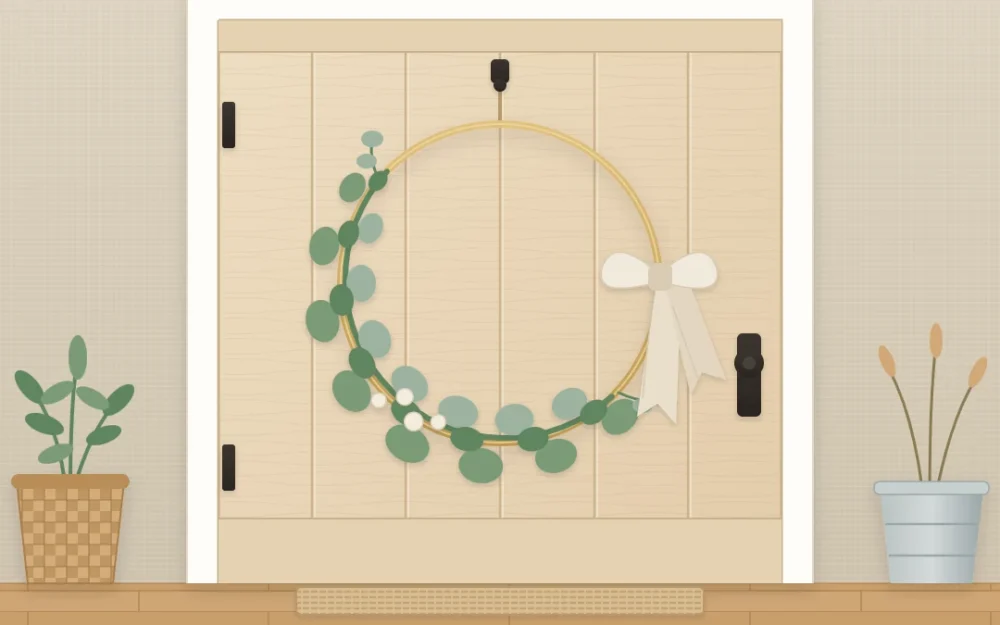
The wreath most at home in a farmhouse room is not the thick, fully covered ring. It is a thin hoop with greenery sweeping around part of it and plenty of air showing through, and it happens to be the easiest kind to make.
This DIY farmhouse wreath takes one hoop, a handful of stems and some wire. If you have never made a wreath before, the steps below get you from loose stems to a finished piece in a single sitting.
What You Need
- A hoop. Metal or wood, in brass, black or a natural finish. About 12 to 14 in (30 to 35 cm) across is a common starting point for a door; smaller hoops suit walls and shelves.
- Greenery stems. Faux or dried, six to ten pieces. Eucalyptus-style, olive-style and fern-style stems all have the loose, slightly wild line that suits the look.
- Floral wire or twine. Thin green or brown wire disappears best. Twine works and adds a rustic note.
- Wire cutters or strong scissors. For trimming stems and wire. Faux stems often have a wire core that ordinary scissors struggle with.
- Optional ribbon. A length of ribbon or a torn strip of linen for a simple tie.
Plan the Shape Before You Wire
Lay the hoop flat on a table and arrange the stems around it loosely. For the open look, cover only a third to a half of the circle and leave the rest bare. The lower left or lower right section is the classic position, a little like a crescent moon tipped on its side.
Sort the stems into three groups as you go: the longest and thinnest for the two ends, medium ones for the body, and the fullest two or three for the middle. Cut long stems into shorter sections, roughly 6 to 8 in (15 to 20 cm), which are far easier to control than whole branches.
Build the Wreath Step by Step
- Attach the first stem. Lay one of the long, thin pieces along the hoop where you want the greenery to begin, with the tip pointing outward. Wrap wire tightly around the cut end and the hoop three or four times.
- Work in one direction. Place the next stem so that its leaves cover the wire of the one before, and wire it on by its cut end. Keep every stem pointing the same way around the circle.
- Thicken toward the middle. As you approach the center of the covered section, use fuller pieces and overlap them more closely. Let a few leaves stray past the hoop on both sides so the shape is not too neat.
- Finish the far end. The last stem’s cut end has nothing to hide behind. Turn one final short piece to face the opposite direction and tuck its end under the leaves of the stem before it, so both ends of the greenery taper to a point.
- Check the back. Turn the wreath over, snip wire tails and fold any sharp ends flat against the hoop.

Tip
Hold the wreath up at arm’s length after every two or three stems. Gaps and lopsided patches are obvious upright and nearly invisible when the hoop lies flat on the table.
Add a Small Focal Cluster
A wreath made of one kind of leaf can look flat. A small focal cluster, set slightly off the middle of the greenery, gives the eye a place to rest. Wire on two or three contrasting pieces close together: a different leaf shape, a few faux berries, a seed head or a short sprig of something paler.
Keep it modest. The cluster should take up no more than a hand’s width. If you are using ribbon, tie it at the point where the greenery ends and let the tails hang, instead of making a large bow that competes with the leaves.
Make a Loop and Hang It
Many hoop wreaths hang directly from the bare top of the hoop. If you prefer a loop, tie a short length of twine or ribbon around the top and knot it, hiding the knot behind the hoop.
On a door, an over-the-door hanger avoids putting anything into the door itself. Otherwise use a hook chosen for the door or wall type, the weight of the wreath and the manufacturer instructions. A hoop wreath is light, but it still swings each time a door opens, so check that it sits securely and does not knock against glass.
Good to know
Dried and faux greenery should stay well away from flames and heat. Do not hang the wreath above or beside lit candles, heaters or any other heat source; flameless LED candles are the simple choice for nearby shelves and tables.
Change It With the Seasons
Because the stems are only wired on, the same hoop can be stripped and remade in a few minutes. Keep the method and swap the materials.
| Season | Greenery | Focal cluster | Tie |
|---|---|---|---|
| Spring | Soft, pale green stems | A few small white blooms | Cream linen strip |
| Summer | Olive-style or fern-style stems | Lavender-style sprigs | None, or plain twine |
| Fall | Dried grasses and muted leaves | Seed heads or small faux pumpkins | Rust or mustard ribbon |
| Winter | Evergreen-style sprigs | Pine cones or faux berries | Dark green or striped ribbon |
A light wreath is one of the quickest swaps in a round of spring farmhouse updates, and an evergreen version fits easily into a simple farmhouse Christmas scheme.
Where a Hoop Wreath Looks Best
The front door is the obvious place, but the open shape works indoors too: on a peg rail in the entry, over a mirror with the glass showing through the bare half, leaning on a shelf behind a jug, or hung on a cabinet door with ribbon. Small hoops in a row of three make a gentle piece of wall decor.
Once you are comfortable with wire and stems, the wreath pairs well with other small makes from this list of simple farmhouse projects.
Frequently asked questions
How much of the hoop should the greenery cover?
For the open farmhouse look, cover roughly a third to a half of the hoop and leave the rest bare. Covering less can look unfinished, while covering much more loses the airy shape that makes a hoop wreath different from a traditional full one. Lay the stems out first to judge the proportion.
Should I use faux or dried stems?
Either works with the same method. Faux stems bend easily, keep their color and can be reused from season to season. Dried stems have a more natural texture but are brittle and shed if handled roughly, so wire them gently and hang the wreath somewhere it will not be knocked.
How do I hide the wire on a hoop wreath?
Always attach each stem by its cut end and lay the next stem so that its leaves fall over that wire. Working in one direction around the hoop means every binding is covered by the following piece. For the very last stem, tuck its end under the leaves of its neighbor.