Farmhouse-Style Signs: Simple Designs With Words of Your Own
What makes a wooden sign look farmhouse, how to choose wording that belongs to your household alone, three ways to letter it, and wordless alternatives.
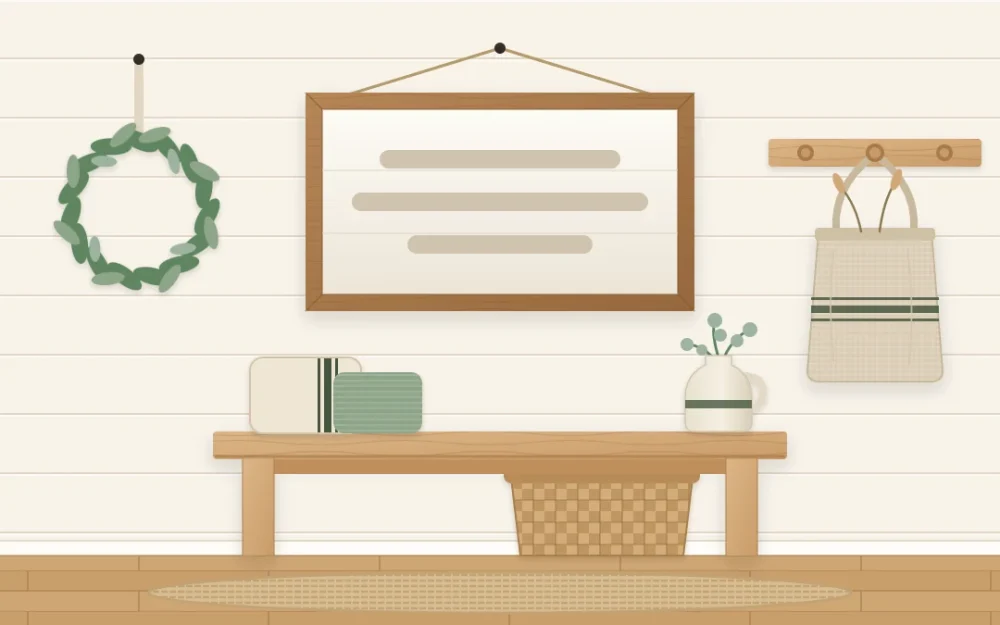
Wooden word signs are one of the most recognizable farmhouse accents, and also the easiest to overdo. The same handful of phrases appears in so many homes that a sign can stop saying anything about the people who live there.
The fix is not to give up on farmhouse signs. It is to make or choose one that could only belong to your house: plain in design, quiet in lettering, and carrying words that are your own.
What Makes a Sign Look Farmhouse
The style comes from restraint, and four features do most of the work.
- A plain board. Flat wood or a wood-look panel in white, cream, soft black or a natural tone. No glitter, no heavy fake distressing.
- A simple frame. Four narrow strips of wood in a slightly darker tone, or no frame at all.
- Restrained lettering. One typeface, or one for the main word and a second, smaller one for a date. Black, charcoal or white, and nothing else.
- Empty space. As a loose guide, the lettering fills about half the board and the rest stays blank. That quiet margin is what keeps the sign calm.
If you remember only one of these, make it the last. A short word with generous space around it looks more considered than a long sentence squeezed to the edges.
Choosing Wording of Your Own
The best sign wording is specific. It names something true about your household that would mean little on anyone else’s wall. Use the table as a set of prompts, not a list to copy.
| Type of wording | How to make it yours | Where it suits |
|---|---|---|
| Family name | Your surname alone, or with the year your household began | Entry, above a console |
| A place | The town, road, lake or farm that matters to your family | Living room, hallway |
| A date | A wedding day, a move-in day or a birthday, written as numbers | Bedroom, stair wall |
| House number | Your number in large plain numerals | Porch, by the front door |
| One everyday word | A plain label for what happens there, such as pantry, boots or garden | Kitchen, mudroom, shed door |
| Your own phrase | A few words you wrote yourself: a family saying or a nickname for the house | Anywhere you pass daily |
A useful test: if a visitor might ask about the sign, it is personal enough. If they have seen the same words in a dozen other homes, keep thinking.
Why Copying Is the Wrong Shortcut
It is tempting to borrow words that already sound finished. Song lyrics, poems, quotations from books and films, and advertising slogans all belong to the people who wrote them, and much of that material is protected. The same goes for logos, cartoon and film characters, and another maker’s sign design that you photographed in a shop or saved from a website.
Leaving those alone is the respectful choice, and it also gives you a better result. Borrowed words date quickly, while a surname, a place or a date stays true for as long as you live there.
Three Ways to Do the Lettering
By hand
Sketch the word lightly in pencil first, using a ruler for a baseline, then go over it with a paint pen or a small brush. Slightly uneven letters are part of the charm. Practice on paper cut to the size of the board until the spacing looks right.
With stencils
Stencil sets of plain alphabets and numerals give crisp, even letters. Dab on a small amount of paint with a nearly dry brush or sponge so it does not creep under the edges. Stick to basic letter stencils, not ready-made phrase stencils, so the wording stays yours.
With a printed font
You can print a word at full size and transfer its outline to the board with pencil rubbed on the back of the paper. Fonts come with licenses, so use one that is licensed for what you plan to do, especially if you ever intend to sell or give away signs.
Whichever way you choose, work in a ventilated space and follow the label on your paint, stain or sealer. A sign is one of several small makes in this list of weekend farmhouse projects, all of which need only basic supplies.
Where a Single Sign Works Best
One sign per room is usually enough, and plenty of rooms need none. Words pull the eye harder than any other decor, so two signs in one view compete with each other and with everything around them.
Good spots give the sign a reason to be there: above a bench in the entry, over a doorway, on a shelf leaned behind a jug, or as the single word piece within a mixed farmhouse gallery wall. Leaning a sign on a mantel, console or shelf is the simplest option and lets you move it with the seasons.
Before you hang anything
Wooden signs vary a lot in weight. Choose hanging hardware for your wall type, the weight of the sign and the manufacturer instructions, and get help with a large or heavy board if you are unsure.
Signs With No Words at All
If nothing you write feels right, skip the words. A board can bring the same shape, frame and warmth to a wall without saying anything.
- A painted plain board. A framed panel in warm white or soft sage, hung as a calm block of color among busier pieces.
- A grain-sack stripe. Three thin lines, one wide and two narrow, painted down the center of a cream board or stitched onto linen and framed.
- A simple silhouette you drew. A leaf, a pitcher, a hen or the outline of your own house, filled in with one flat color.
- Bare wood. A handsome board with a clear matte finish and a narrow frame, valued for its grain alone.
These wordless versions sit happily beside mirrors, wreaths and baskets. For more ways to fill an empty wall without leaning on lettering, see these farmhouse wall decor ideas.
A Quick Check Before You Finish
Stand across the room and ask three questions. Can you read it without effort? Is there more blank board than lettering? Would the words still be true in ten years? Three yeses mean the sign has earned its place.
Frequently asked questions
What should I write on a farmhouse sign?
Choose something specific to your household: your surname, a place that matters to you, a meaningful date, your house number, one plain word that labels the spot, or a short phrase you wrote yourself. Specific wording stays meaningful for years and keeps the sign from looking like one found in every other home.
How many signs are too many in one room?
More than one is usually too many. Lettering draws attention more strongly than other decor, so several signs compete with each other and make a room feel themed. Keep to a single sign in any one view, and let mirrors, baskets, prints and greenery do the rest of the work on the walls.
Can I use any font I find online for a sign?
Not automatically. Fonts are distributed under licenses that say what they may be used for, and some allow personal projects only. Check the license before you print, particularly if you plan to sell or give away what you make. Hand lettering and plain alphabet stencils are simple alternatives.