Farmhouse Gallery Wall: Mixing Frames, Baskets and Botanical Prints
How to choose and place the pieces for a collected-looking gallery wall: wood and black frames, botanical prints, a mirror, a basket, and a layout planned on the floor first.
At a glance
- Difficulty
- Intermediate
- Time
- About 2 to 3 hours, including the floor layout
- Best for
- The wall above a sofa, bench or console
- Look
- Collected, textured, neutral with soft green
What you need
- Wood and black frames
- Botanical or landscape prints
- Small round mirror
- Flat woven basket
- Kraft paper and scissors
- Low-tack painter's tape
- Tape measure and pencil
A wall of identical frames in a strict grid can look sharp, but it rarely looks like a farmhouse. A farmhouse gallery wall feels gathered over time: a few prints, a small mirror, something woven, something green, all held together by a short list of colors and materials.
That relaxed look still needs a plan. The steps here take you from a pile of candidates to a finished arrangement, with the decisions made on the floor and on paper before anything touches the wall.
What Goes Into the Mix
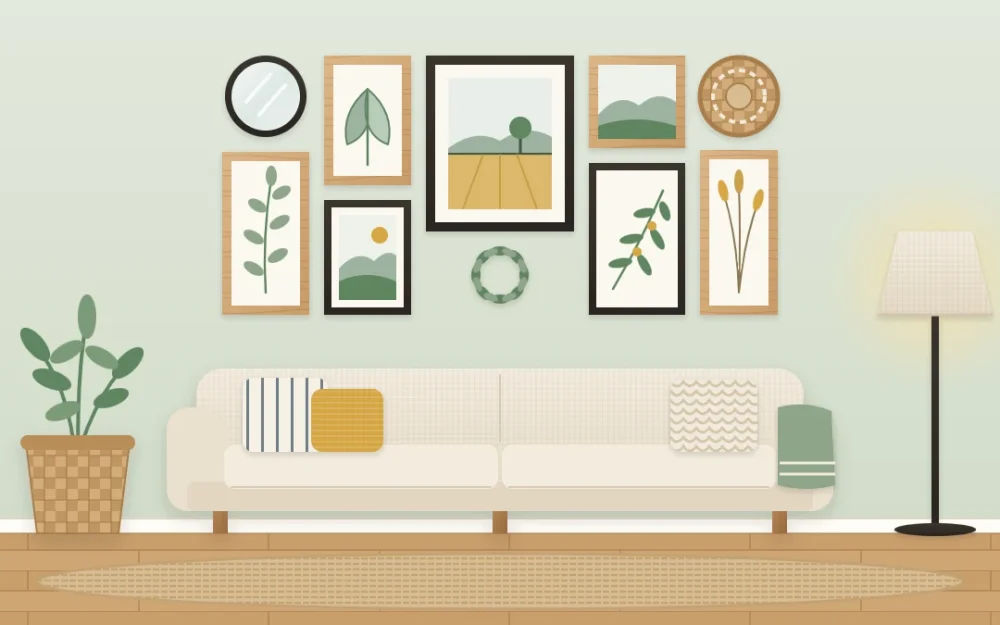
The character comes from combining flat art with a few objects that stand off the wall. For a group of seven to nine pieces, a common starting point is five or six framed items and two or three objects.
- Wood and black frames: two finishes are enough. Light or mid-toned wood brings warmth; slim black gives the group an outline.
- Botanical or landscape prints: simple leaves, stems, fields and trees in quiet colors.
- A small mirror: round is easiest, because it breaks up all the rectangles.
- A flat woven basket: a shallow tray-style basket hung face out adds texture and a second round shape.
- A little wreath: a small hoop of faux or dried greenery, no bigger than your smallest frame.
- An empty vintage-style frame: a frame with nothing in it, hung as a shape in its own right.
If you would like a word piece in the group, keep it to one and make the wording yours; the guide to simple farmhouse-style signs explains how.
Keep the Palette Short
Variety in shape needs restraint in color. Choose two frame finishes, one mat color (white or cream) and artwork that stays within three or four tones, such as soft green, charcoal, cream and a warm brown. Lay everything out together and remove whatever jumps forward. Usually it is one bright print or one ornate frame.
Black frames beside rougher wood ones is a good example of pairing clean and rustic on purpose, an idea covered more fully in the guide to balancing modern and rustic pieces.
Use Art That Is Yours to Use
You do not need to buy a matching set. The most personal walls are filled with your own material: photos you took of a garden, a field or a family place, printed in black and white; leaves you pressed; a pencil sketch; a child’s drawing in a plain frame; a scrap of ticking-stripe fabric behind glass.
If you print images from elsewhere, choose prints you have the right to use. Pictures found online are not automatically free to print and frame, so look for work sold or shared by its maker for that purpose.
Lay It Out on the Floor
Clear a patch of floor about the size of the wall area you want to fill, and mark its width with two strips of tape.
- Start with the largest piece. Place it slightly off-center, not in the middle. Everything else is arranged around it.
- Add the second-largest piece on the opposite side and a little higher or lower, so the weight is balanced without mirroring.
- Fill in with medium frames, then tuck the objects into the spaces left over. Spread the round shapes apart instead of clustering them.
- Even out the gaps. A common starting point is roughly 2 to 3 in (5 to 8 cm) between pieces, kept about the same throughout. Consistent gaps are what make mixed pieces look like one group.
- Check the outline. The outer edge should suggest a loose rectangle or oval, with no single piece drifting off on its own.
Take a picture from above before you move anything. It becomes your map.
Size the Group to the Furniture
A gallery wall above a sofa, bench or console looks anchored when it relates to that piece. As a rule of thumb, let the whole group span about two-thirds of the furniture’s width and center it on the furniture, not on the wall. Start the lowest pieces roughly 6 to 8 in (15 to 20 cm) above the sofa back, close enough that the two read together.
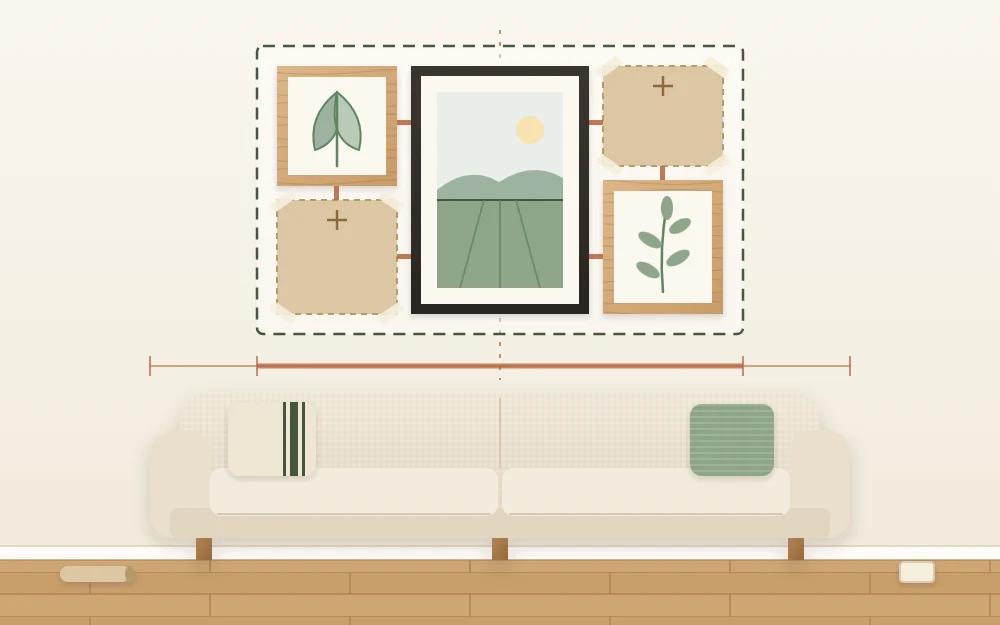
On a wall with no furniture below, a common starting point is to set the middle of the group at about 57 in (145 cm) from the floor, then adjust by eye for the room.
Trace Paper Templates
Trace each piece onto kraft paper or newspaper and cut the shapes out with scissors. On every template, mark the point where the hanger on the back of the piece sits. Fix the templates to the wall with small pieces of low-tack painter’s tape, following your floor layout.
Paint finishes vary, so test the tape in a hidden spot first and take it off slowly. Then stand back, sit on the sofa, and look at the arrangement from the doorway. Moving paper costs nothing, so shift templates until the gaps and the outline feel right.
Hang From the Middle Outward
Put up the largest piece first, then work outward, checking each gap with a tape measure as you go. Remove each template once its piece is in place.
Before you hang anything
Choose hanging hardware for your wall type, the weight of each piece and the manufacturer instructions for both the hardware and the frame. Mirrors and glazed frames are heavier than they look; if you are unsure about a heavy piece, ask someone experienced to help.
If a finished wall looks spotty, the gaps are probably too wide; if it looks heavy on one side, swap a dark frame with a lighter piece. Not every wall needs a group, though. When the room already has plenty going on, one of these simpler farmhouse wall decor ideas may suit it better.
Frequently asked questions
How many pieces does a gallery wall need?
It depends on the wall and the furniture below it. Five pieces can fill the space above a small bench, while seven to nine suit a full-length sofa. An odd number is often easier to arrange without it turning into a grid. Start with fewer than you think; you can always add one later.
Do all the frames have to match?
No, and a farmhouse arrangement usually looks better when they do not. Two finishes, such as light wood and slim black, give enough variety while keeping order. What matters more is that the mats share one color and the artwork stays within a few quiet tones, so the mix looks chosen instead of random.
Can I include a basket or wreath among framed prints?
Yes. Objects with depth are what give this kind of wall its character. Keep them to two or three, spread them apart, and treat each one like a frame when planning: trace it onto paper, give it the same gap as everything else and place it inside the overall outline of the group.